


 Special Cert.
 Management and Business Acumen Advancement(MBAA)
“Empowering Top Management and Business Intelligence” International Certification Course
Course Objectives:
1. Enhance Strategic Thinking and Decision-Making Capabilities
Utilize systematic management theories and real-world case studies to help participants master global business trend analysis and strategic planning methods, enhancing executive decision-making skills.
Cultivate the ability to quickly identify opportunities and risks in complex market environments, enabling precise business strategy formulation.
2. Deepen Business Intelligence and Management Philosophy
Explore the integration and application of Eastern and Western management philosophies within the unique multicultural context of Macau, enhancing participants' leadership and management artistry.
Analyze cutting-edge business cases to help participants understand innovation-driven business logic and master the core elements of sustainable enterprise development.
3. Expand International Perspective and Cross-Border Resources
Leverage Macau's international platform to gain insights into global market dynamics and emerging business models, broadening participants' international business perspective.
Provide opportunities for interaction with global entrepreneurs, scholars, and industry leaders to promote cross-border collaboration and resource integration.
4. Build High-End Networking and Empower Growth
Create an executive-level business networking platform to help participants connect with elites from various fields and establish long-term collaborative relationships.
Foster innovative thinking and leadership potential through interactive learning and team collaboration, empowering both individuals and enterprises to grow together.
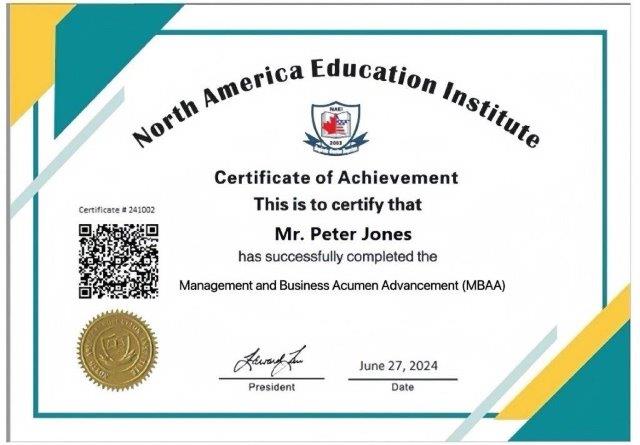
Remark:
Completion of the required hours and passing assessments are necessary to otain the NAEI course certificate.
Course Outline:
Course Module and Content Overview
Module 1: Essentials for Enterprises Going Global
Global international culture, market insights, cross-cultural management.
Module 2: Strategic Thinking and Planning
Fundamentals of strategic management, environmental analysis, strategy formulation.
Module 3: Change Management
Change theories, implementing change, evaluation and feedback.
Module 4: Digital Asset Management
Innovation-driven, high growth, decentralization.
Module 5: Decision-Making and Analysis
Decision theories, application of decision models, problem-solving techniques and practices.
Module 6: Innovation Management
Interdisciplinary integration, forward-looking flexibility, systematic results orientation.
Assessment and Reflection
Evaluation assessments, practical exercises, reflection and sharing.
Detailed Course Content and Schedule:
Module I: Enterprises should know how to go to sea
Course content:
Case teaching:
Combining rich cases of enterprises going global, analyzing successful experiences and lessons learned from failures, helping students better understand and apply the knowledge of enterprise going global they have learned.
Practical exercises:
By simulating negotiations, role-playing, and other practical exercises, students can enhance their cross-cultural communication and problem-solving abilities.
Expert guidance:
Invite entrepreneurs and experts with rich international experience to give lectures, share practical experience and insights.
Module 2: Strategic Thinking and Planning
Course Content:
Fundamentals of Strategic Management:
Explain the basic concepts, processes, and importance of strategic management.
Use case studies to understand the role of strategic thinking in business success.
Environmental Analysis:
Learn the PEST (Political, Economic, Social, Technological) analysis method to grasp external environmental influences.
Use SWOT (Strengths, Weaknesses, Opportunities, Threats) analysis to identify internal and external factors affecting the organization.
Strategy Formulation:
Engage in group exercises to create short-term and long-term strategic goals.
Discuss how to translate strategic goals into actionable plans.
Module 3: Change Management
Course Content:
Change Theories:
Introduce Kotter’s Eight-Step Change Model and understand the importance of each step.
Study successful and failed change cases to analyze key lessons.
Implementing Change:
Learn effective change communication strategies, including stakeholder identification and management.
Role-play to simulate communication and feedback processes during change implementation.
Evaluation and Feedback:
Establish mechanisms for post-change evaluation.
Learn how to collect and analyze feedback, and develop adjustment strategies to ensure the sustainability and effectiveness of changes.
Module 4: Digital Asset Management
Course Content:
Cutting-edge Insights:
Stay updated on the latest trends in digital assets and share industry insights and case analyses.
Digital Identity and Data Sovereignty:
Understand the concepts of digital identity and data sovereignty.
Explore how blockchain technology can protect personal data privacy and security.
Metaverse and Digital Economy:
Discuss future trends in the metaverse and examine the application of digital assets in this context.
Practical Orientation:
Combine real-world cases and data analysis to help participants understand and apply digital asset knowledge and skills.
Blockchain Technology and Digital Assets:
Deep dive into the principles of blockchain technology and explore its empowerment of digital assets, achieving decentralization, transparency, and security.
Module 5: Decision-Making and Analysis
Course Content:
Decision Theories:
Introduce classic decision theories, including rational decision theory, bounded rationality, and intuitive decision models, to understand their characteristics and applicable scenarios.
Application of Decision Models:
Explain common decision models (e.g., decision trees, cost-benefit analysis) and learn how to apply these tools through case studies to enhance scientific decision-making abilities.
Problem-Solving Techniques and Practice:
Learn methods for problem identification and definition (e.g., fishbone diagram, 5 Whys analysis).
Master techniques for breaking down complex problems and developing solutions through case analysis and group decision simulation exercises, enhancing quick decision-making under pressure.
Module 6: Innovation Management
Course Content:
Design Thinking and Innovation:
Learn the methodologies of design thinking, focusing on user-centered innovation to break mental barriers and stimulate creativity.
Cross-Industry Collaboration and Ecosystems:
Explore how to break industry boundaries and collaborate with enterprises, institutions, and individuals from various fields to create an innovative ecosystem that facilitates resource sharing and complementary advantages.
Change Management and Organizational Resilience:
Understand the theories and practices of change management, learning how to respond to challenges brought by change and enhance organizational adaptability and resilience.
Innovation Performance Evaluation and Improvement:
Learn the indicators and methods for assessing innovation performance, and how to evaluate innovation outcomes for continuous improvement of innovation management processes.
Course Delivery Institute:
MACAU MILLENNIUM COLLEGE
ADDRESS:Alameda Dr. Carlos d’Assumpção No. 255
China Civil Plaza 8- andar, Macau
TEL:(853) 2878 8186
FAX:(853) 2878 8246
E-MAIL:info@mmc.edu.mo
