


 Special Cert.
 Leadership and Strategic Management Skills Enhancement Course (LSMSE)
Course Objectives:
1. Strengthen Strategic Thinking and Decision-Making Capabilities:
Enhance leaders' abilities to formulate long-term development plans.
2. Integrate Leadership Theory with Practice:
Improve leaders' application skills in dynamic environments through a combination of leadership theories and hands-on experience.
3. Promote Collaboration and Communication in Cross-Departmental Cooperation:
Enhance overall team effectiveness by fostering collaboration among leaders.
4. Increase Adaptability and Flexibility in Change and Crisis Management:
Equip leaders to respond to challenges and drive organizational progress effectively.
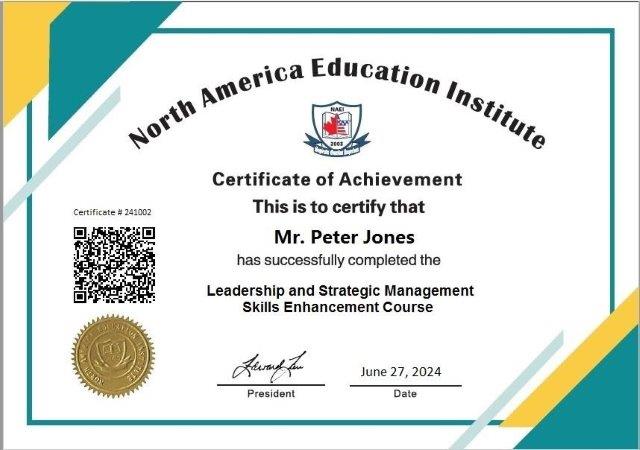
Remarks:
Completion of the required hours and passing assessments are necessary to obtain the NAEI course certificate.
Course Outline:
Course Module and Content Overview
Module 1: Leadership Foundations and Strategic Thinking
Leadership style analysis, self-assessment, thinking training, fundamentals of strategic management, environmental analysis, strategy formulation.
Module 2: Team Collaboration and Communication
Team building, effective communication, conflict management.
Module 3: Digital Leadership and Innovation Management
Digital transformation, building and assessing an innovation management culture, application of DeepSeek in teaching.
Module 4: Teaching and Research Innovation Thinking
Innovative teaching methods, expanding research thinking, interdisciplinary strategies, integration of teaching and research, guidance on outcome transformation.
Module 5: Assessment and Reflection
Evaluation assessments, practical exercises, reflection and sharing; certificate issuance (if applicable).
Free Activity: Macau Tour
Exploration of Macau.
Detailed Course Content and Schedule:
Module 1: Leadership Foundations and Strategic Thinking
Course Content:
Leadership Style Analysis:
Discuss different leadership styles (e.g., transformational, transactional, charismatic). Participants engage in group discussions to share their personal leadership styles.
Self-Assessment:
Use tools (e.g., 360-degree leadership assessment) for self-evaluation. Analyze results and develop a personal development plan.
Thinking Training:
Foster innovative thinking skills through group discussions.
Fundamentals of Strategic Management:
Explain the basic concepts, processes, and importance of strategic management. Use case studies to understand the role of strategic thinking in business success.
Environmental Analysis:
Learn the PEST (Political, Economic, Social, Technological) analysis method to grasp external influences. Use SWOT (Strengths, Weaknesses, Opportunities, Threats) analysis to identify internal and external factors.
Strategy Formulation:
Engage in group exercises to establish short-term and long-term strategic goals. Discuss how to translate strategic goals into actionable plans.
Module 2: Team Collaboration and Communication
Course Content:
Team Building:
Explain the five stages of team development (forming, storming, norming, performing, adjourning). Conduct team role analysis to identify members' strengths and weaknesses.
Effective Communication:
Learn fundamental communication principles and skills (e.g., listening, feedback, non-verbal communication). Practice communication skills through group activities to enhance team interaction.
Conflict Management:
Identify types and causes of conflict, and learn conflict resolution strategies (e.g., collaboration, compromise, avoidance). Engage in conflict management simulations to practice handling different types of conflicts within a team.
Module 3: Digital Leadership and Innovation Management
Course Content:
Digital Transformation:
Explore trends and impacts of digital transformation. Learn methods for developing and implementing digital strategies while overcoming transformation challenges.
Building and Assessing an Innovative Management Culture:
Learn strategies for creating an innovative culture. Understand key performance indicators and assessment methods for innovation management. Design frameworks to evaluate innovation outcomes and support continuous improvement.
Application of DeepSeek in Teaching:
Learn the basic concepts and foundational applications of DeepSeek, as well as its combination with other platforms for enhanced effectiveness.
Module 4: Teaching and Research Innovation Thinking
Course Content:
Innovative Teaching Methods:
Explore project-based learning and flipped classroom techniques to stimulate student engagement and enhance problem-solving abilities.
Expanding Research Thinking:
Break traditional boundaries by fostering backward and divergent thinking, guiding participants to uncover topics from new perspectives.
Interdisciplinary Strategies:
Integrate knowledge and methods across disciplines. For example, combine environmental science with various fields, or merge literature and history to explore social landscapes.
Integration of Teaching and Research:
Promote collaboration between teaching and research, ensuring research outcomes are integrated into teaching practices and refining research questions from teaching experiences.
Guidance on Outcome Transformation:
Support the application of research outcomes in practical settings, such as translating new technologies into production processes or applying educational innovations to teaching reforms, providing comprehensive guidance throughout the process.
Module 5: Assessment and Reflection
Course Content:
Evaluation Assessments:
Conduct assessments to evaluate learning outcomes.
Practical Exercises:
Engage in practical exercises to reinforce learning.
Reflection and Sharing:
Facilitate discussions for participants to reflect on their experiences and share insights gained throughout the course.
Course Delivery Institute:
MACAU MILLENNIUM COLLEGE
ADDRESS:Alameda Dr. Carlos d’Assumpção No. 255
China Civil Plaza 8- andar, Macau
TEL:(853) 2878 8186
FAX:(853) 2878 8246
E-MAIL:info@mmc.edu.mo
