


 Special Cert.
 International Exhibition Planner Certification (IEPC)
International Exhibition Planner Certification
Course Objectives:
1. Master Basic Knowledge of Exhibition Planning:
Help participants gain a comprehensive understanding of the fundamental concepts, processes, and relevant regulations in the exhibition industry.
2. Enhance Project Management Skills:
Develop participants' organizational, coordination, and execution abilities in exhibition project management.
3. Strengthen Marketing Skills:
Improve participants' marketing, brand building, and customer relationship management capabilities within the context of exhibitions.
4. Cultivate Team Spirit:
Enhance participants' teamwork and communication skills for effective collaboration.
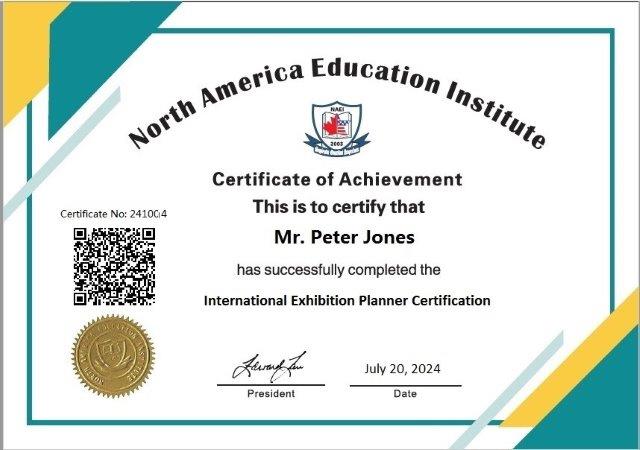
*The NAEI (North American Education Institute) course certificate will only be awarded upon passing the relevant examination.
Course Module and Content Overview
Module 1: Overview of the Exhibition Industry
Basic knowledge of exhibitions, industry regulations and policies, market trend analysis.
Module 2: Exhibition Planning Process
Project initiation, planning and design, budget and resource management.
Module 3: Marketing and Promotion
Market research, promotional strategies, brand building.
Module 4: Project Management and Execution
Team management, on-site management, evaluation and feedback.
Assessment and Reflection
Evaluation assessments, practical exercises, reflection and sharing.
Detailed Course Content and Schedule:
Module 1: Overview of the Exhibition Industry
Course Content:
- Basic Knowledge of Exhibitions:
Definition and Classification:
Introduce the definition of exhibitions and explore different types (e.g., trade shows, conferences, events).
Industry Importance:
Analyze the impact of the exhibition industry on the economy, culture, and business.
2. Industry Regulations and Policies:
Laws and Regulations:
Study relevant laws and regulations related to exhibitions, such as contract law and intellectual property law.
Industry Standards:
Understand the standards and norms within the exhibition industry, including safety, health, and environmental requirements.
3. Market Trend Analysis:
Industry Trends:
Research development trends in the exhibition industry, such as digital transformation and sustainability.
Case Studies:
Analyze successful and unsuccessful cases to identify best practices and lessons learned in the industry.
Module 2: Exhibition Planning Process
Course Content:
1. Project Initiation:
Needs Analysis:
Learn how to conduct market research to determine client needs and target audiences.
Project Goals:
Set clear project objectives and key performance indicators (KPIs).
2. Planning and Design:
Theme Creation:
Develop the exhibition theme and design exhibition content and layout.
Resource Planning:
Identify required resources, including venue, equipment, and personnel.
3. Budget and Resource Management:
Budget Preparation:
Learn how to create a detailed budget, including revenue and expenditure forecasts.
Funding Sources:
Explore funding sources, including sponsorship, ticket sales, and government grants.
Module 3: Marketing and Promotion
Course Content:
1. Market Research:
Data Collection:
Learn how to collect market data and feedback from exhibitors, and conduct competitive analysis.
Target Audience:
Identify the characteristics and needs of the target audience.
2. Promotional Strategies:
Online Promotion:
Utilize methods such as social media, email marketing, and SEO for online promotion.
Offline Promotion:
Conduct offline promotion through traditional media, promotional materials, and on-site events.
3. Brand Building:
Brand Positioning:
Develop brand positioning strategies that define the core values and image of the brand.
Brand Communication:
Explore how to communicate the brand through multiple channels to enhance brand awareness.
Module 4: Project Management and Execution
Course Content:
1. Team Management:
Team Building:
Learn how to select and cultivate exhibition team members, clarifying roles and responsibilities.
Team Collaboration:
Enhance team cooperation and communication through team-building activities.
2. On-Site Management:
Operational Management:
Develop an on-site operational plan to ensure smooth event execution.
Service Management:
Focus on the service experience of exhibitors and attendees, addressing on-site issues promptly.
3. Evaluation and Feedback:
Evaluation Mechanisms:
Establish evaluation mechanisms, including metrics for exhibition effectiveness and attendee satisfaction.
Summary and Improvement:
Analyze feedback results, propose improvement suggestions, and provide references for future events.
Assessment and Reflection
Course Content:
Class Participation:
Evaluate attendance, discussion, and interaction in the classroom.
Group Projects:
Conduct group assignments at the end of each module, submitting specific planning proposals focusing on practical applications.
Final Project:
Each participant must independently or collaboratively complete a comprehensive project, including planning a complete exhibition scheme that covers planning, execution, and evaluation aspects.
Reflection and Sharing:
Engage in reflection and share insights gained throughout the course.
Course Delivery Institute:
MACAU MILLENNIUM COLLEGE
ADDRESS:Alameda Dr. Carlos d’Assumpção No. 255
China Civil Plaza 8- andar, Macau
TEL:(853) 2878 8186
FAX:(853) 2878 8246
E-MAIL:info@mmc.edu.mo
